
From content
generation to intelligent workflows: How agentic AI could transform marketing
in financial services.
Maximilian
Hartmann | Senior Marketing Manager at 21X
For years, the promise of artificial
intelligence in marketing has been relatively straightforward: produce more
content, faster and at lower cost. AI can draft articles, generate social media
posts, summarize research and develop campaign variations in seconds.
But what happens when AI moves beyond
producing individual outputs and starts managing the processes behind them?
Recent developments suggest this transition
is already underway. And for B2B marketing teams operating in complex,
regulated industries, the implications extend far beyond productivity.
40 million agents – but what are they actually doing?
In a July 2026 Forbes article, Rachel Wells
highlighted a remarkable milestone: Microsoft CEO Satya Nadella reported nearly
40 million AI agents registered through Agent 365 within two months, alongside
more than 30 million paid Microsoft 365 Copilot seats.
However, the more revealing finding
concerns how people use AI.
According to Microsoft’s 2026 Work Trend
Index, 49% of analyzed Copilot user goals involved cognitive work, including
analysis, problem-solving and decision support. Only 17% focused on producing
outputs, while 19% involved working with others and 15% finding information.
These figures describe Copilot usage rather
than the activities of all registered agents. Nevertheless, they point toward
an important development: AI’s role is expanding from content production to
supporting more sophisticated knowledge work.
For marketing, this raises a fundamental
question: Are we using AI to accelerate individual tasks, or are we redesigning
the way marketing operates?
From isolated prompts to intelligent workflows
Traditional generative AI follows a
relatively simple model: a person submits a request, and the system produces an
output.
Agentic AI introduces a different approach.
Rather than responding to a single prompt, an AI agent can execute a sequence
of connected tasks, use approved information sources, evaluate results and
initiate subsequent steps within defined boundaries.
Consider market intelligence in financial
services. A conventional AI assistant can summarize an article about tokenized
securities. An AI agent could monitor regulatory developments, identify
relevant announcements, compare them with previous market activity and assess
potential implications for institutional investors.
It could then recommend whether the
development warrants a thought leadership article, a LinkedIn discussion or
further internal investigation. The distinction is significant. One approach
accelerates content creation. The other supports the decision-making process
that determines which content should exist in the first place.
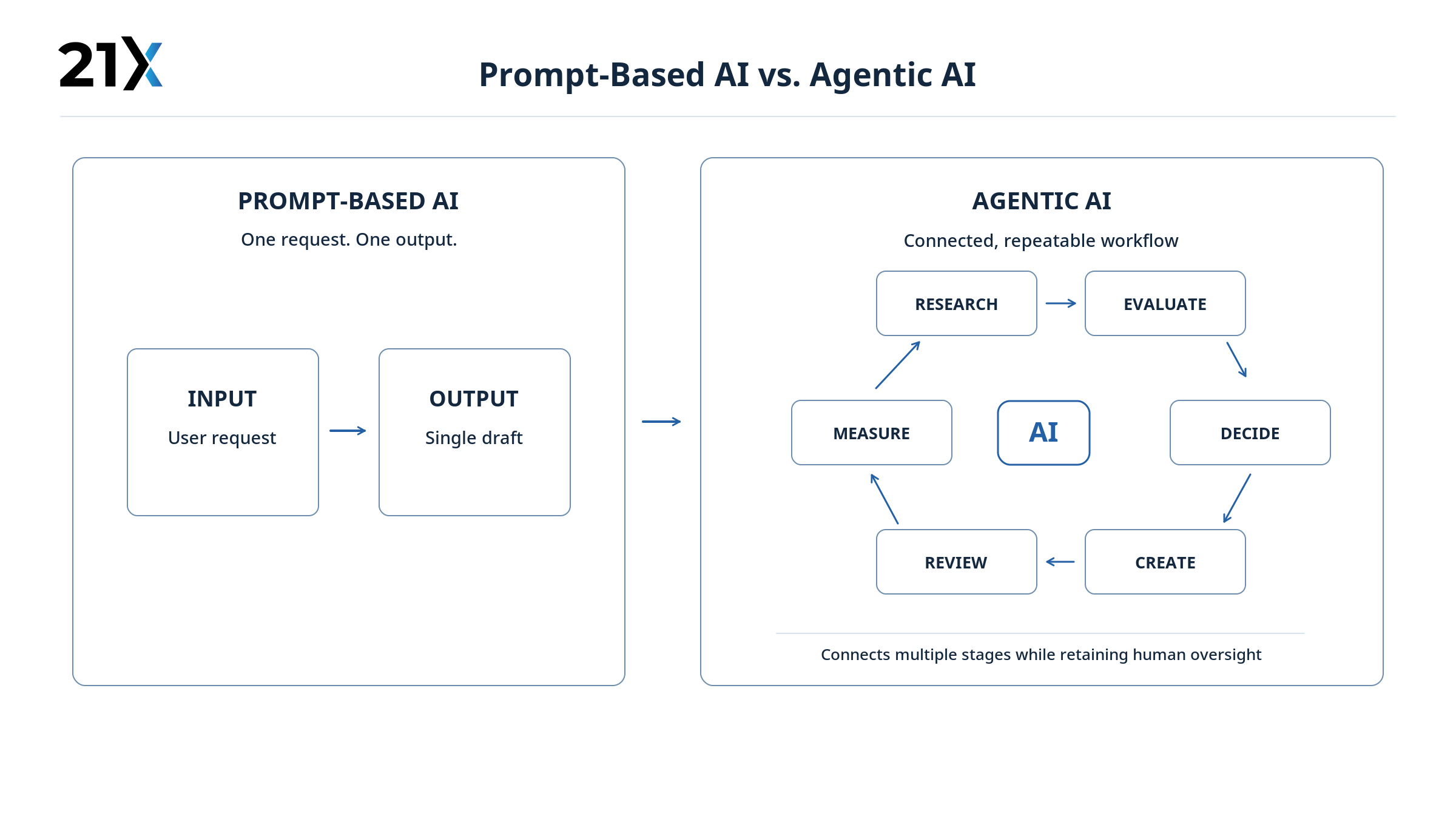
Fig.
1: Prompt-based AI produces an individual output; agentic AI coordinates a
recurring workflow.
Five applications that could reshape financial marketing
For financial institutions, several use
cases stand out.
Market
intelligence. Agents can continuously monitor
regulatory announcements, industry publications and emerging technologies,
identifying developments that deserve attention.
Competitive
intelligence. Rather than periodically reviewing
competitors, agents can track changes in positioning, partnerships and product
announcements, helping teams identify emerging narratives.
Thought
leadership. Research, source verification, article
development and editorial reviews can become connected stages of a structured
workflow, allowing specialists to focus on original insights and strategic
arguments.
Content
distribution. A single approved article can serve
as the foundation for social media posts, newsletters, visual briefings and
sales materials, with each format adapted to its audience.
Performance
intelligence. Agents can consolidate marketing
metrics, identify meaningful changes and recommend improvements instead of
merely reporting impressions, clicks and engagement.
These applications share a common
characteristic: their value comes from connecting activities that have
traditionally been managed separately.
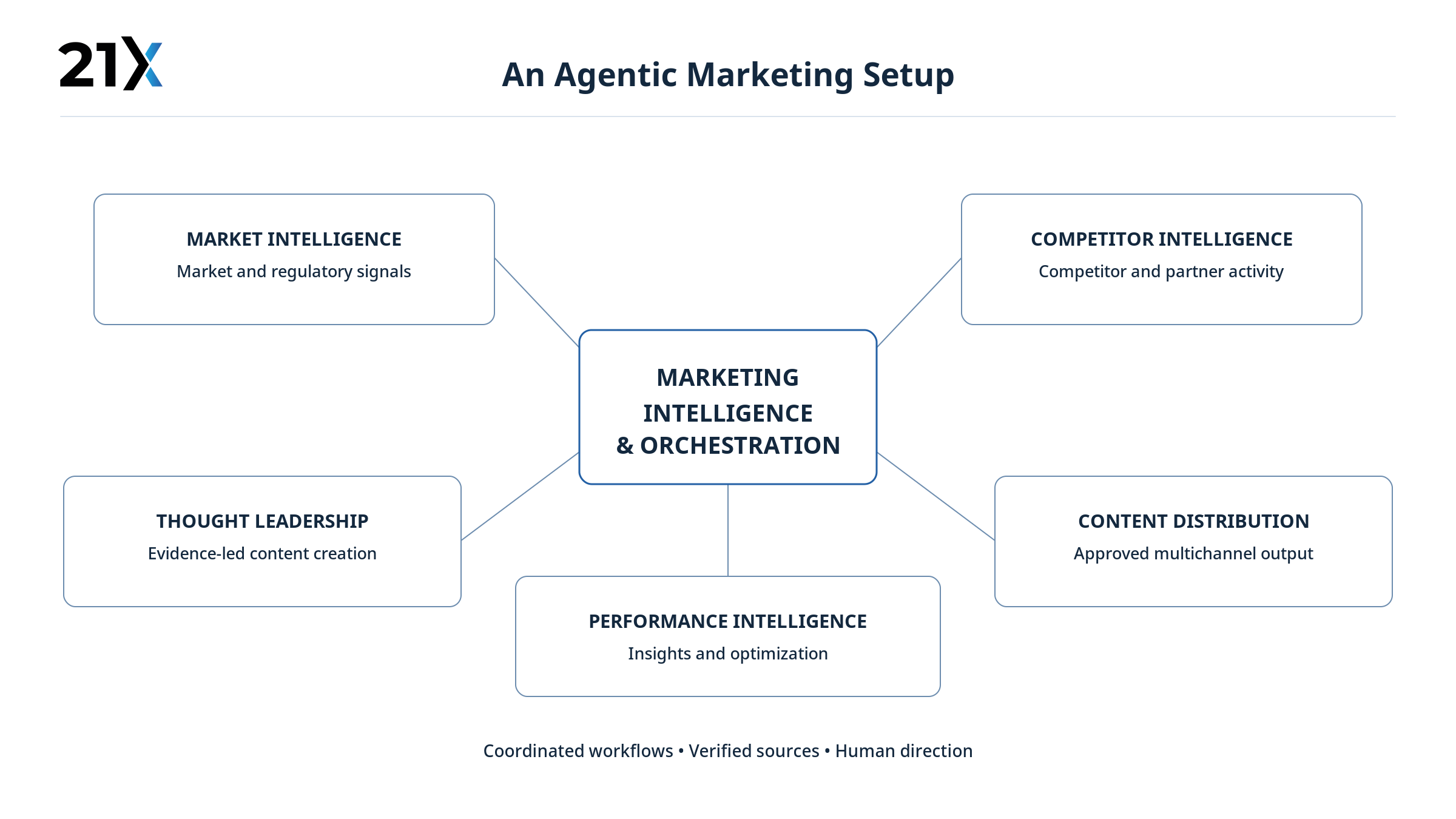
Fig.
2: A coordinated agent setup connects five core marketing functions.
Why human judgment becomes more important
Greater automation does not eliminate
responsibility.
Microsoft’s research found that 50% of
surveyed AI users considered quality control of AI outputs increasingly
important, while 46% emphasized critical thinking. Furthermore, 86% treated
AI-generated results as a starting point rather than a final answer.
In financial services, this distinction is
particularly relevant. An agent might identify a compelling market development,
but it cannot independently assume responsibility for the accuracy of
regulatory interpretations or public statements.
The same applies to claims concerning
financial products, partnerships, authorizations and market infrastructure.
Effective agentic workflows therefore
require clear controls: approved sources, defined responsibilities, documented
reviews and human authorization before external publication. For regulated
businesses, governance is not an obstacle to automation. It is what makes
automation dependable.
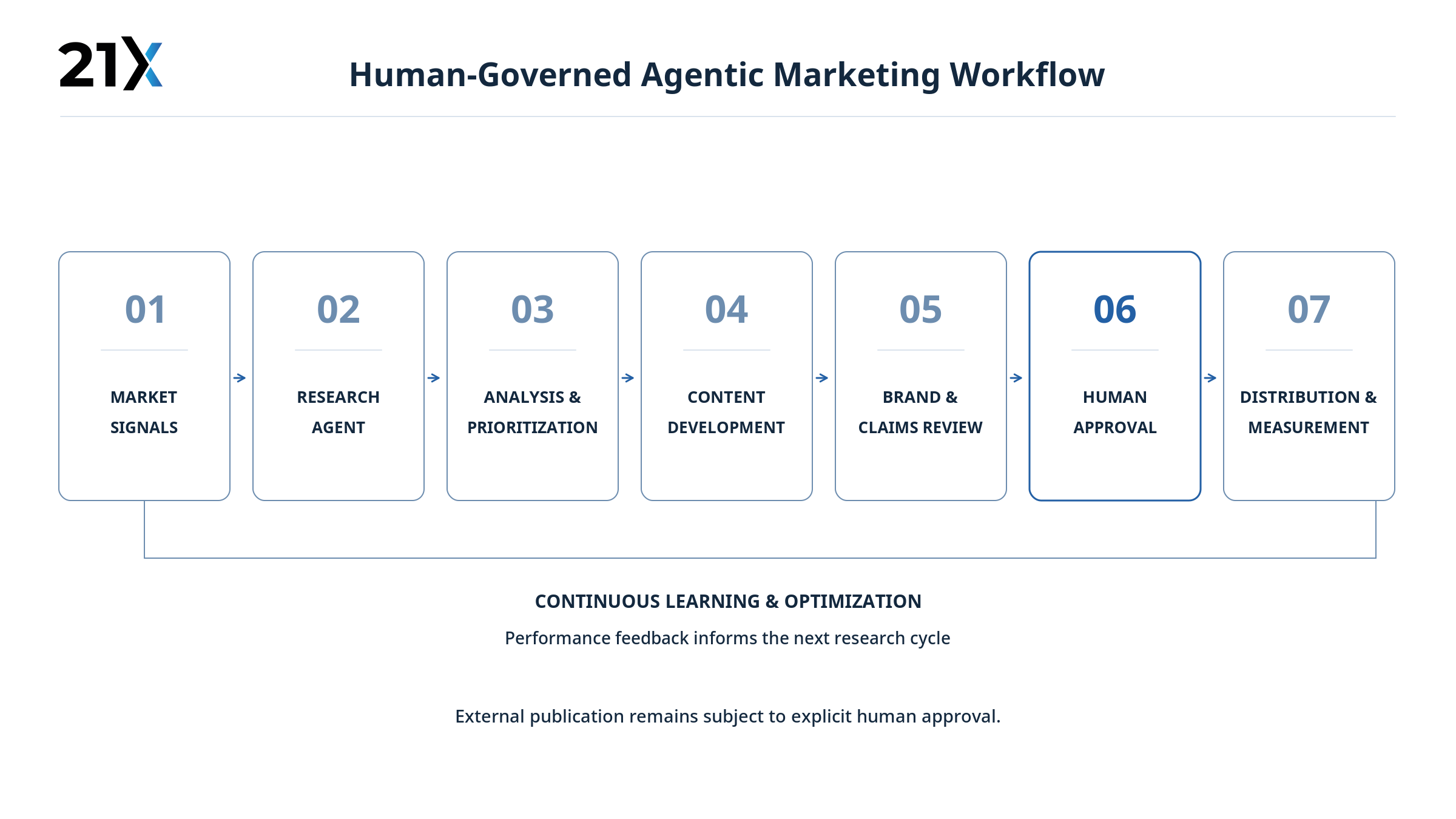
Fig.
3: A human-governed workflow keeps review and publication decisions under human
control.
The next competitive advantage is operational
Marketing teams should not begin by
deploying dozens of autonomous agents.
A more practical approach is to identify
recurring processes that involve research, analysis, evaluation and multiple
execution steps. Start with one workflow. Define its inputs, decisions,
approval requirements and measurable outcomes. Introduce AI where it improves
consistency, speed or analytical depth. Expand only when the benefits can be
demonstrated.
This approach reflects a broader lesson
from financial market infrastructure.
At 21X, we see how meaningful technological
progress depends on rethinking the processes underlying existing systems,
rather than simply digitizing individual steps.
A similar principle applies to marketing:
optimizing isolated activities delivers incremental improvements. Reconsidering
how those activities connect creates the potential for structural change.
From content production to accountable intelligence
The future of B2B marketing will not be
determined by which organization generates the most AI-powered content.
It will depend on which teams can identify
relevant developments earlier, translate complex information into meaningful
perspectives and act with greater precision while maintaining accountability.
AI agents could make that operating model
increasingly achievable.
But the decisive advantage will remain
human: knowing which questions matter, which insights deserve attention and
which decisions should never be delegated.
The next chapter of AI in marketing is not about
generating more content. It is about building smarter systems for deciding what
matters – and acting on it responsibly.
Sources
Forbes,
Rachel Wells (July 31, 2026) —
https://www.forbes.com/sites/rachelwells/2026/07/31/microsoft-deployed-40-million-ai-agents-what-are-they-being-used-for/
Microsoft
Work Trend Index (2026) —
https://www.microsoft.com/en-us/worklab/work-trend-index/agents-human-agency-and-the-opportunity-for-every-organization