Author: Max J. Heinzle, CEO, 21X
Vlad Tenev, co-founder and chief executive officer of Robinhood, published a piece recently arguing that global markets have entered a “tokenization supercycle“, and that tokenization is the best available path to modernizing the American financial system. (Tokenized Stocks in America | Vlad Tenev (@vladtenev – on X)
His case is worth reading in full, but the short version is this. Robinhood has built its own blockchain, Robinhood Chain, and now offers tokenized exposure to more than 190 US stocks across 120 countries, backed one-for-one by the underlying shares. Tenev is candid that these instruments deliver economic exposure rather than direct legal ownership. The real prize, he argues, lies elsewhere: making financial assets portable, programmable, self-custodiable and tradable around the clock. Tokenization, in his words, is not about putting stocks on a blockchain. It is about rebuilding the infrastructure underneath ownership so that assets can move as freely as information moves on the internet.
He is right on all of it. If anything, he is understating the pace.
Some perspective on where this market actually is
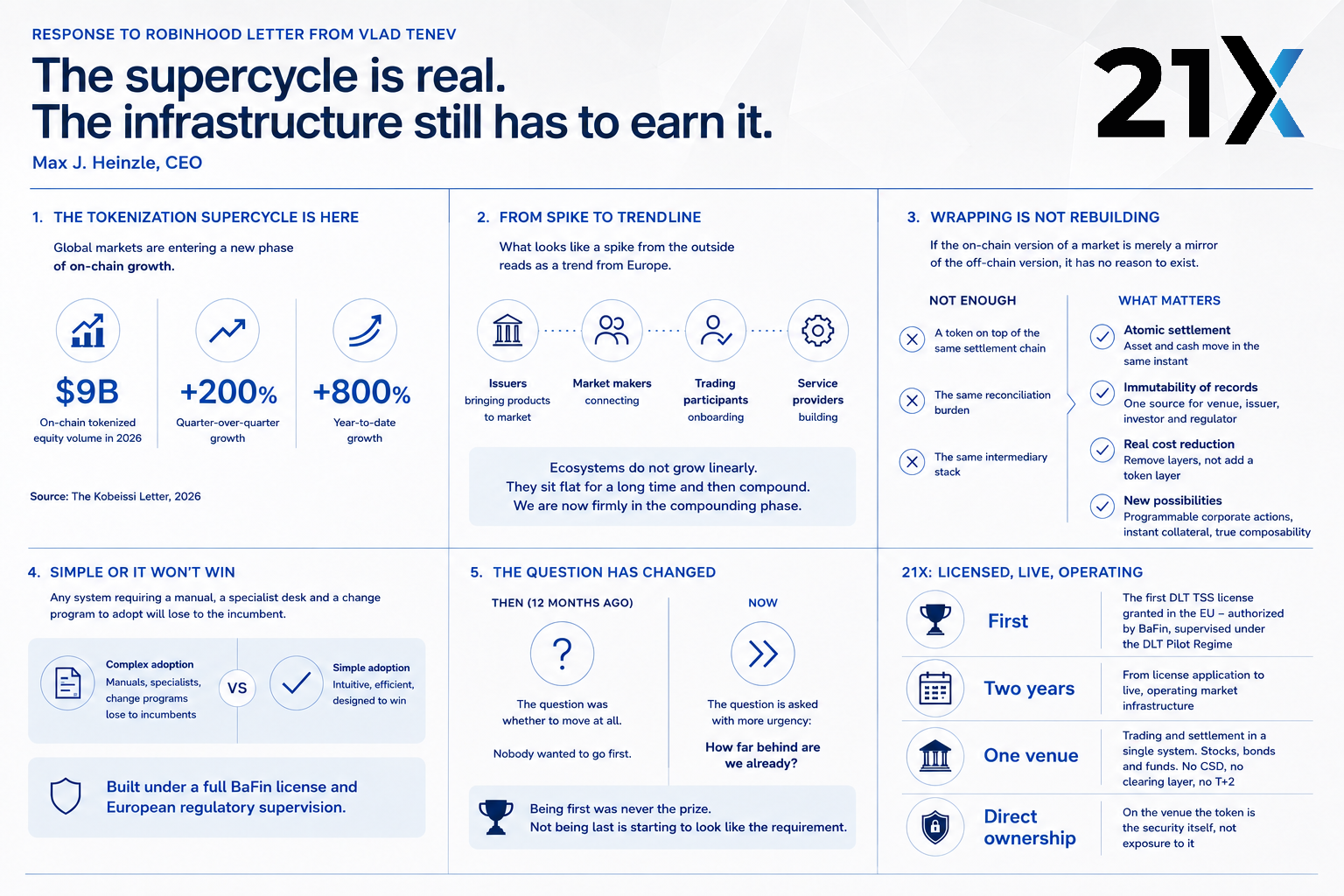
The figure circulating alongside his piece comes from the Kobeissi Letter (Tokenized asset growth is exploding – on X): Around $9 billion of on-chain tokenized equity volume globally in 2026, up more than 200% quarter-over-quarter and more than 800% year-to-date. Against the daily turnover of any major exchange that is a rounding error, and the skeptics are welcome to say so. But nobody who has watched a market form judges it by the base. They judge it by the slope. An 800% run on a curve this young is not a spike. It is a market finding its footing.
Markets form fastest where the rules arrive first. The EU’s DLT Pilot Regime gave regulated venues a legal path to issue, trade and settle real securities on-chain, and the market moved into that space quickly. At 21X we now see the pattern from both sides of the book: issuers bringing stocks, bonds and funds to market, market makers connecting, trading participants onboarding, and service providers building around the exchange because there is finally something licensed to build around. Ecosystems do not grow linearly. They sit flat for a long time, and then they compound. We are firmly in the compounding phase.
That same demand is now visible well beyond the venues serving it today. While we are only in the early stages of planning what is possible for 21X in the United States, I will say this about it: the research coming back from that market is some of the most encouraging work on my desk. Issuers and investors are asking sharper questions than they were a year ago, and asking them far earlier in the conversation. The appetite is not regional. It is arriving everywhere at once, and it is arriving faster than the infrastructure built to serve it.
Wrapping is not rebuilding
None of this is guaranteed, because volume can be bought and infrastructure cannot. If the on-chain version of a market is merely a mirror of the off-chain version, it has no reason to exist. A token sitting on top of the same settlement chain, the same reconciliation burden and the same intermediary stack is a marketing layer. It will not survive contact with a serious institutional balance sheet.
Matching the infrastructure we already have is not an achievement. The new rails have to beat it outright, and beat it on the terms institutions actually care about.
Start with time. Legacy markets keep office hours; on-chain markets do not, and once assets move on-chain, 24/7 global trading stops being a feature and becomes the default. Then settlement. Multi-day clearing cycles collapse into real-time finality, so counterparty risk is not managed, it is removed. Then reach. A tokenized instrument is accessible across borders by design, which puts equities and real-world assets in front of investors that no local exchange was ever going to serve. Then the record itself. Venue, issuer, investor and regulator read from one immutable source, and an audit becomes a query rather than a reconstruction. Then cost, achieved properly, by stripping out layers of intermediation rather than stacking a token layer on top of the ones already there. And finally, the instruments that simply could not exist before: programmable corporate actions, collateral mobilized in seconds rather than days, products that compose with one another instead of sitting in silos.
It also has to be simple. Any system requiring a manual, a specialist desk and a change program to adopt will lose to the incumbent, however elegant the technology underneath. Efficiency only an engineer can see is not efficiency.
That is the standard we built 21X against, under the DLT Pilot Regime, supervised by BaFin and ESMA.
The question has changed
The clearest signal is not in the announcements. It is in the budgets. Building dedicated infrastructure, pursuing licences and hiring the people to run both are slow, expensive commitments, and none of them are signed off on the strength of a pilot. Firms do not fund a proof of concept for three years. They fund the things they expect to depend on.
Which brings me to the shift I notice most in boardrooms. Twelve months ago the question was whether to move at all, and nobody wanted to go first. That question has quietly disappeared. What I hear now is asked with far more urgency: how far behind are we already?
Being first was never the prize. Not being last is starting to look like the requirement.