A technological transformation in capital markets
Asset tokenization is transforming how financial instruments are issued, traded, and settled. By representing economic rights to assets as digital tokens on blockchain-based distributed ledger technology (DLT), tokenization creates a more efficient infrastructure layer for capital markets without changing what assets fundamentally represent or yield.
What is asset tokenization?
Asset tokenization refers to the process by which economic rights to an asset such as ownership, receivables, income or repayment claims are represented as digital tokens on a blockchain through smart contracts. The token acts as a technically programmed and legally structured representation of these claims. Smart contracts define and automate the rules for issuance, redemption and transferability, while the blockchain serves as a shared, immutable register of ownership and transaction history.
Key clarifications: The underlying asset remains unchanged tokenization does not alter risk, return or legal nature, only access and record-keeping. A token is not merely a digital representation, but a smart-contract-controlled instrument with explicitly defined behaviour. The blockchain does not replace regulation; it serves as the technical execution layer for existing legal structures.
Regulatory framework
European legislators have established dedicated legal frameworks that formally recognize blockchain-based securities. Germany’s Electronic Securities Act (eWpG) introduced the regulated role of the crypto securities registrar to ensure that smart-contract-based securities are issued and maintained in compliance with capital markets law. One such licensed registrar is Cashlink.
“Token-based capital markets have the potential to fundamentally reshape how financial instruments are issued, settled and accessed. By replacing fragmented, legacy systems with programmable, DLT-based financial market infrastructure, they can reduce complexity and lower costs by up to 85%. At Cashlink, we are building the leading infrastructure for token-based capital markets to enable this transformation at scale and bring capital markets fully into the digital age.”
Simon Censkowsky
Head of Business Development, Cashlink
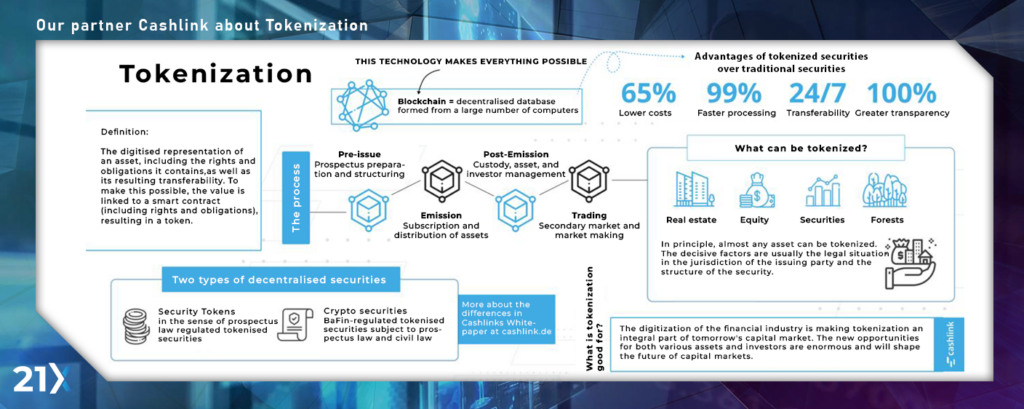
Fig 1: Source Cashlink “Tokenization”
What can be tokenized?
A wide range of assets can be tokenized, provided that the underlying rights and obligations can be clearly defined and legally enforced:
Real estate: Properties structured via shares, notes or fund units representing ownership or economic participation.
Equity: Stakes in private or public companies, including venture investments or employee participation schemes.
Securities: Bonds, notes, certificates and other financial instruments with clearly defined cash flows.
Funds: Money market funds, bond funds or investment funds, where tokenization improves settlement efficiency.
Commodities: Precious metals or energy resources, backed by physical custody or contractual delivery claims.
Infrastructure assets: Energy, transport or digital infrastructure projects with long-term, predictable cash flows.
How asset tokenization works
Tokenization follows a clear five-step sequence:
- Define economic rights: A legally issued financial instrument with clearly defined economic and governance rights is established.
- Encode rules via smart contracts: Rights are translated into enforceable logic governing issuance, transfer conditions, and restrictions.
- Issue tokens on blockchain: Tokens are issued on a blockchain-based ledger functioning as a tamper-resistant register.
- Primary issuance: Tokens are subscribed and allocated, with payment and delivery potentially synchronised.
- Secondary trading: Tokens are traded and settled on the same platform, enabling near-real-time ownership transfer.
The economic relevance emerges primarily at this final stage without secondary market access, tokens remain operationally constrained.
Benefits of asset tokenization
Improved Liquidity: Lower barriers to secondary trading, particularly for traditionally illiquid assets, with 24/7 trading infrastructure.
Fractional Ownership: Smaller units reduce minimum investment sizes. A €10 million property can be represented as 10 million €1 tokens.
Higher Operational Efficiency: Smart contracts reduce manual reconciliation. Processes requiring 3-5 intermediaries consolidate into programmable logic. Issuers report 40-60% reduction in operational costs versus traditional issuance.
Faster Settlement: Near-real-time settlement replaces T+2 cycles, improving capital efficiency and reducing counterparty risk.
Transparency: Immutable transaction records simplify verification. All transfers are recorded on-chain with cryptographic proof.
Programmable Compliance: Eligibility rules and restrictions are enforced at transaction level, automatically blocking unauthorized transfers.
Cost savings from tokenization: A quantitative analysis
A comprehensive study by FinPlanet, Cashlink, and Porsche Consulting provides concrete evidence of cost reductions across the entire value chain.
The research adopted a “bottom-up” approach, comparing a conventionally issued bearer bond with a crypto security under Germany’s eWpG, analyzing process workflows, expert interviews, and price specifications.
Key Finding: DLT-based capital market infrastructure can realize cost savings of up to 85% in middle and back office processes by 2028 compared to existing infrastructure. Even today, there is potential for up to 22% cost savings.
Where Savings Are Generated:
Corporate Actions & Asset Servicing: Automated dividend and interest distribution through smart contracts eliminates manual processing.
Clearing & Settlement: Near-instantaneous settlement removes multi-day cycles and extensive reconciliation needs.
Registry and Custody: Blockchain-based registries provide a single source of truth, eliminating multiple parallel ledgers.
Compliance and Reporting: Programmable rules automate regulatory checks, reducing manual review.
The study projects savings growing from 22% today to 85% by 2028 as infrastructure matures, standards converge, and regulatory frameworks become fully operational.
Implications: Lower issuance costs make smaller offerings viable for issuers, enable competitive fee structures for intermediaries, and reduce expense ratios for investors. The magnitude indicates tokenization is a structural shift, not incremental improvement.
The current tokenization landscape
Institutional tokenization is expanding across asset classes, but adoption is not uniform. McKinsey describes tokenization growth as unfolding in successive adoption waves, driven by regulatory clarity, liquidity structure and operational complexity, with the market potentially reaching around $2tn by 2030 in its base case scenario.
In practice, these waves can be grouped into three observable phases.
Phase 1: debt instruments
The first wave has centred on bonds and securitized note structures, where legal enforceability is well established and cashflows are clearly defined.
- Société Générale-FORGE: Has issued digital bonds on blockchain infrastructure, demonstrating that regulated fixed-income instruments can be recorded and settled on DLT rails without altering their legal nature.
- Black Manta Capital Partners: Structures tokenized securitized notes via regulated vehicles, embedding traditional debt claims into DLT-based issuance frameworks rather than replacing established securitization law. Structurally, note-based products such as USMO fall into this broader debt category.
This phase progressed first because debt instruments benefit from standardized documentation, defined repayment profiles and strong legal clarity.
Phase 2: money market funds
The second phase focuses on short-duration, cash-like products, where high transaction frequency amplifies operational efficiency gains.
- BlackRock – BUIDL: Provides tokenized money market exposure backed by cash, U.S. Treasuries and repos, illustrating how traditional fund exposure can be operationally represented onchain without changing economic risk.
- Franklin Templeton – FOBXX (Benji): Operates as a U.S.-regulated government money market fund with tokenized share register mechanics recorded on blockchain infrastructure.
- USMO: Is a tokenized tracker note referencing the UBS (Irl) Select Money Market Fund – USD and traded on regulated DLT infrastructure, integrating issuance, secondary market access and settlement within a single venue.
In this phase, tokenization primarily enhances transferability, operational handling and potential collateral usability rather than altering economic exposure.
Phase 3: trading products
The third phase extends tokenization into actively traded securities and broader market access products.
- Ondo Global Markets: Provides tokenized exposure to U.S.-listed equities and ETFs, enabling economic participation through blockchain-based distribution structures.
- Galaxy Digital: Has announced initiatives to tokenize its own publicly listed shares via institutional infrastructure, illustrating that tokenized representations of listed equity are being explored within regulated capital market frameworks.
This phase signals a structural evolution: tokenization is moving beyond issuance efficiency toward becoming a cross-asset capital markets execution layer.
“RWA volumes are scaling at a pace the industry has not seen in decades. We are at the same structural inflection point ETFs created for fund distribution – but this time for the entire capital markets value chain. Asset managers who fail to integrate tokenization into their issuance and distribution strategy risk losing access to the next generation of investors and liquidity.”
Philip Filhol, Senior Business Development Manager at 21X
Real-World use cases
Tokenization is applied where efficiency and capital mobility matter most:
Issuance: Native DLT issuance reduces complexity and time-to-market.
Secondary trading: Atomic trade and settlement reduce operational friction.
Collateral financing: Intraday margining and faster collateral substitution.
Fund management: Automated subscription, redemption and reporting.
Treasury management: Dynamic liquidity control beyond traditional settlement cycles.
KEY TAKEAWAY: Tokenization delivers value in workflows involving frequent transfers and settlement not in static, buy-and-hold strategies.
Risks and limitations
While tokenization reduces operational friction, it does not create liquidity automatically. Economic outcomes depend on market structure, investor demand and supporting infrastructure.
Key risks include:
Liquidity: Lower technical barriers don’t replace market makers or active participation.
Legal enforceability: Token robustness depends on underlying legal structure and documentation.
Custody risks: Private key control and recovery processes introduce operational risks.
Smart contract risk: Coding errors and administrative privileges have functional consequences.
Privacy constraints: Public blockchains are transparent by default, conflicting with institutional confidentiality needs.
Tokenization shifts these risks into a new technical environment; benefits materialise only where legal frameworks, technology and market infrastructure align.
Why Tokenize?
| 24/7 | 65% | 99% | 100% |
| Global Trading | Lower Costs | Faster Settlement | More Transparency |
Conclusion
Asset tokenization is an infrastructure upgrade that transforms how assets are issued, transferred, and settled without changing what they fundamentally represent.
What Tokenization Delivers:
✅ Faster settlement (T+2 → near-instant)
✅ Lower costs (22-85% reduction potential)
✅ Broader access (fractional ownership, 24/7 markets)
✅ Programmable compliance
✅ Improved capital efficiency
What It Does NOT Deliver:
❌ Automatic liquidity
❌ Higher yields
❌ Elimination of regulatory requirements
❌ Zero operational risk
Critical Success Factors: Legal clarity, infrastructure maturity, market participation, and risk management.
The value lies in measurable efficiency gains: faster settlement, lower costs, broader distribution. The risks are manageable but real. The market is moving from proof-of-concept to institutional adoption. The question is no longer ‘if’ tokenization will scale, but ‘how quickly’ supporting infrastructure and regulation will align.
Glossary of key terms
Atomic Settlement: Trade and settlement occurring simultaneously in a single transaction, eliminating counterparty risk during the settlement window.
AUM (Assets Under Management): Total market value of assets managed by a fund or asset manager.
DLT (Distributed Ledger Technology): Shared database technology without central control, enabling multiple parties to maintain synchronized records.
DLT Pilot Regime: European Union regulatory framework allowing experimentation with DLT-based market infrastructure under controlled conditions.
ERC-20: Ethereum token standard defining common functions for fungible tokens, enabling interoperability across applications.
NAV (Net Asset Value): Per-share value of a fund, calculated by dividing total asset value by number of outstanding shares.
Oracle: Technical bridge delivering verified off-chain or cross-chain data to smart contracts.
Smart Contract: Self-executing code on a blockchain that automatically enforces predefined rules without intermediaries.
T+2: Trade date plus two business days standard settlement cycle for traditional securities.Tokenization: Representing economic rights to assets as blockchain-based tokens controlled by smart contracts
Further articles for you:
Why the next leap in efficiency is not called tokenization but collateral mobility
Tokenization alone does not create efficiency. What truly matters is that tokenized money market products can move seamlessly as collateral within regulated, integrated markets.
The state of tokenization
Tokenization is no longer an abstract concept but an infrastructural evolution in which assets are implemented as digital, executable market objects on DLT.
The state of tokenization – Part 2
The focus shifts from definition to execution: DLT, smart contracts, and regulated infrastructures demonstrate how tokenization is already being adopted at an institutional level.
Connect with us